


Content block block-1435117569-1792205417
Health Department Closures
The primary reason that a health permit is suspended at a retail food facility is due to an immediate health hazard. "If any imminent health hazard is found, unless the hazard is immediately corrected, an enforcement officer may temporarily suspend the permit and order the food facility closed. Imminent health hazard means a significant threat or danger to health that is considered to exist when there is evidence sufficient to show that a product, practice, circumstance, or event creates a situation that can cause food infection, food intoxication, disease transmission, vermin infestation, or hazardous condition that requires immediate correction or cessation of operation to prevent injury, illness, or death." (As specified in Sections 113810, 114405 & 114409 of the California Health & Safety Code)
Several conditions are considered to be imminent health hazards and could lead to a health permit suspension.
Potentially hazardous foods in a facility cannot be stored in a safe manner (i.e. properly temperature controlled)
Example: An electrical power outage causes all refrigeration units to stop working, which prevents the ability to maintain proper temperatures of potentially hazardous food.
Lack of hot water throughout the facility
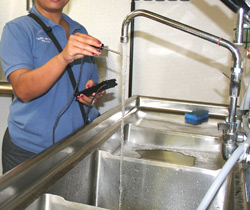 Example: Hot water only measures at or below 99°F at all sinks in a facility where food preparation and/or washing of multi-use utensils occurs.
- Open Food Establishments Selling Pre-packaged Foods:
A "Health Permit Downgrade" shall be offered to open food establishments that sell prepackaged foods as a significant part of their regular food sales (e.g., supermarkets, movie theatres, liquor stores, concession stands, schools, etc.) - Pre-packaged Only Food Establishments:
Lack of hot water in a prepackage food establishment does not warrant an immediate Health Permit suspension. A reinspection for hot water must be conducted within 48- hours or the next business day following a weekend. A Notice of Violation would be issued to any prepackaged establishment that fails to provide hot water within the time frame specified.
Lack of potable water throughout the facility.
Example: Due to a break in the water main, the water has been shut off, and no water is available at the facility.
A sewage system backup.
Sewage is observed to be overflowing anywhere inside the food facility.
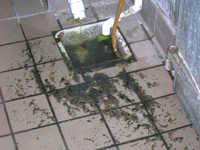 Example: One or more floor sinks and/or toilets are backing up onto the floor.
Sewage is observed to be overflowing onto the property outside the facility and it is determined that the food facility is contributing to the overflow.
Examples: Sewage originating from the clean-out line is overflowing onto the property outside. Sewage originating from a manhole is overflowing onto the grounds outside a strip mall. All food facilities connected to this sewage line shall have their health permits temporarily suspended.
None of the toilets within a food facility are available for employee use.
Example: None of the toilets in a food establishment, including common restrooms, are in working order.
Rodent activity is observed in critical areas of the food establishment, leading to possible adulteration of food products or any food contact surface.
Definition of Critical Area: Any area of the food establishment where food is stored, prepared, or served. A critical area also includes areas where food contact items are stored. Additionally, a critical area is any area, piece of equipment, utensil, or food item where if cross-contamination hazards exist there is an increased potential for food items or individuals to become contaminated, posing an adulteration hazard to food items or an increased health risk to employees or customers.
Activity/evidence may include, but is not limited to, live rodents, rodents in traps, numerous fresh rodent droppings in multiple areas of the facility, urine, and gnaw marks on food packages. Rub marks on wall surfaces and around possible entry points may also be evidence of rodent activity within the food establishment, but by itself does not constitute an imminent health hazard.
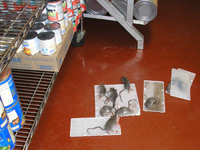
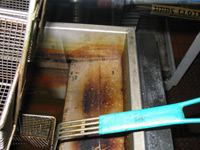 Example: Numerous fresh droppings are observed on floor surfaces in more than one area of the facility, on food, or on food preparation surfaces.
Live cockroach activity is observed in critical areas of the food establishment leading to the adulteration of food products and risk to public health. Other evidence may include, but is not limited to, spotting, egg casings, and dead cockroaches.
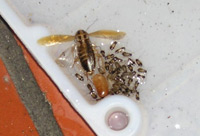 Example: Live cockroaches are observed climbing up the wall next to the 3-compartment sink.
The quantity of other vermin present in critical areas of the food establishment is large enough (i.e., too numerous to count) that the public's health is at risk).
 Example: A fly infestation in the meat market was so bad that you had to continually swat them away from your face.
The potential of communicable disease transmission by one or more food facility staff.
Example: The Person-In-Charge fails to report two or more employees experiencing Acute Gastrointestinal symptoms and complaints of foodborne illness are reported.
A fire or other disaster has occurred, where the structural integrity of the facility has been compromised and/or contamination of the kitchen is large enough that an immediate public health risk exists.
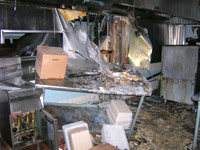
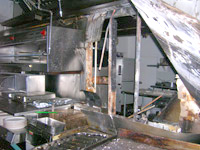 Example: A small grease fire has caused the fire suppression system to discharge, causing extensive contamination to food and food contact surfaces in the kitchen.
Any other condition not mentioned above that constitutes an imminent health hazard to the public's health and cannot be immediately corrected.
Examples: Establishment conducting a remodel in critical areas during business hours without the food being adequately protected. Severe unsanitary conditions are observed throughout the facility.
After a health permit suspension:
When a health permit is suspended, the food facility is not closed permanently. Once the imminent health hazard has been abated, and the conditions that caused the hazard have been corrected, the food facility operator may then contact Environmental Health to request a follow-up inspection. A suspended, revoked, or downgraded permit may be reinstated (or a new permit issued) if the enforcement agency determines that the conditions that prompted the suspension, revocation or downgrade no longer exist.
Links in this section relate to Body